
I enter this writing as a Black woman. I am mothering four beautiful children—ages 13,11, 9, and 4—at the time of this writing. I am pursuing my doctoral degree at a Predominantly White Institution (PWI) in the South and write this at a time when universities have lost their way. Diversity is under attack and cultural programming is being hijacked—including at my own institution, where Comparative Race and Ethnic Studies (CRES) and Women and Gender Studies (WGST) departments have been dismantled. I also write this narrative at a time when young, Black male professional athletes have taken their own lives—including 24-year-old Marshawn Kneeland1 and 25-year-old Rondale Moore.2 I say their names and send my condolences to their families and loved ones. During this era of chaos, those of us working to expose sinister systems that undermine Black student progress can easily feel disenchanted. But we must hold on to hope, focus on possibility, and believe in our abilities to still win.
The only way for me to write this literacy narrative is as a braided story—one typically defined by its strands of two or more topics woven together.3 From within this structure, I hope my story becomes clearer—not just in my literacy journey but also how I learned to honor ways Black boys and football players read their worlds despite them sometimes being cast as illiterate. My multiple subject positions—wife, mother, scholar, teacher, activist, and Black feminist—allow for these narratives to coexist together in ways that deepen, complicate, and further extend my literacy development while at the same time expose the challenging paths Black boys traverse. My overarching stories are related—discussing a shared theme—navigated from the football fields and told through a splintered voice. I open my narrative using my perspective as a mother, then expand my lens through my work as a “literacy specialist” supporting Black student-athletes at a private Predominantly White Institution (PWI) in the South, separate from the university where I am enrolled. The PWI could easily cast these young Black men as illiterate, but I refused that definition because I knew its matrix was flawed, the people administering were biased, and the system was yet another example of ways Black athletes—and other Black students by extension—are failed by a PWI. Literacy practices are embedded in the lives of Black football players based on how they read their worlds, make critical decisions, and expose their feelings—and Black women make valuable contributions to the football apparatus when we work alongside Black men and boys. I return to these moments through my roles as a wife and Black feminist to advance key ideas that connect football and literacy experiences. Within my personal narrative, I also use academic scholarship to bring my multiple subject positions into an artistic space—one that invokes the magic of the braided essay and leaves room for the unsayable.4
Trucking White Supremacy’s Low Expectations of Black Boys’ Literacy using Black Mothering5
My first story begins with the quotidian labor of mama work—laundry—when I discovered my 11-year-old son A’s journal. On this day, I was specifically sorting through A’s dirty clothes to wash his football uniform for his upcoming game. Noticing the journal resting at his bed, I paused my clothing search and thumbed through the pages because I was curious: what was A writing? He had selected the book himself when we were purchasing back to school supplies, and I had grabbed my own journal. When he asked if he could have one too, I shrugged and said sure, but hid my excitement. Maybe he would take up the mantle I was hoping to bequeath to at least one of my children—my insatiable love for words.
With my hunt for dirty socks, jerseys, and padded uniformed pants momentarily suspended, I sat on the bed and opened his book. Although I was arguably violating a space he had designated as his own, I was A’s mother—more than the invisible launderer of his dirty clothes—and wanted access to his words. As a Black mother, there are moments when I must traverse spaces that may seemingly be designated as private ones belonging only to my children. But part of my job as a mother is to invade their worlds and prepare them for another—one that may be hostile and won’t always take kindly to Black kids. As Imani Perry writes, “the ethics of living with a roulette wheel of Black death are complicated.”6 Although death was not in our purview, Black boys are denied the opportunity to live unbothered, as the shortened lives of Tamir Rice, Trayvon Martin, and countless others reveal how racist hate eclipses Black boyhood. Therefore, Black feminist mothers are now reimagining possibilities for motherhood as sites of resistance to white supremacist hatred and crucial to the Black freedom struggle.7 This Black mother encroaches into her children’s seemingly private spaces: journals, text messages, and bedrooms to ensure her kids remain healthy and safe. The ethics around these invasions are, in fact, complicated. But any tools I can access—insights I can glean from their own worlds—will support my efforts.
As I read through A’s writing, to my surprise—and even my delight—his sentences were crafted around his engagements with football. A was using literacy to connect his love with his sport and narrate his day-to-day experiences. His writing process invoked his own inner Derrick Henry; and there were feelings—real feelings—his journal made space for what the football field foreclosed. A never told me he gets afraid on the field, but his journal did. In fact, his worries matched my own. There are palpable fears for Black boys on the football field when they are not just running from the possibility of being clobbered by other large boys. I, too, feel angst as I watch him play—hoping he won’t get hurt. As brief as his sentences were—ones reminding him to be fearless and others that spoke of his fatigue—those snippets were enough for me to understand and further connect with my budding son.
Black mothers have long theorized about raising Black children. From Audre Lorde to Patricia Hill Collins, Alexis Pauline Gumbs, Nicole Carr, and countless others, Black women intellectualize their experiences as Black mothers in ways I, too, find meaningful. In addition to raising A and his siblings, working with Black college football players allowed me to forward the ‘othermother’ tradition and transform into the bourgeois auntie because of the trust we built in one another. The margins of the football field remain a critical space—one sustained by mothers and other Black women whose labor ensures Black boys can express and extend their boyhoods, or at the very least, remain eligible to play. We watch our boys compete and are overcome with emotions the field refuses to acknowledge—and the sidelines won’t understand our sweat. My heartbeat races when I see A get tackled and my stomach drops after certain plays, fearing he could get concussed. Even though he reminds himself through his journaling that he has equipment for a reason that will protect him, there is never enough armor I can wear as his mother to shield my own fears and vulnerabilities.
The happenings on the football field often move beyond the sport itself. When young men struggle with mental health issues and take their own lives, my heart bleeds for the mothers who carry memories of their sons from the fields. Although Marshawn Kneeland’s mother died in 2024 before her son’s passing, Candace Owens—mother of Kyren Lacy, a former Louisiana State University rising football star who took his own life after a police chase—currently mourns the life of her beloved son. Owens watches LSU games in the wake of her son’s death with the field serving as a space to honor his life when Lacy’s teammates still wear his number. Owens acknowledges the anxiety she had to face, saying “I wasn’t going to watch the LSU game, but I sat there by myself, and I said I can’t run from this all season.”8 Black mothers who have lost their sons to police violence know Owens’ pain, but a mother who watches college football alone in grief could also remember the countless youth fields they traversed together for Lacy to eventually attend LSU. Black feminists such as Audre Lorde have discussed pain and silence—particularly during moments of fear and heartache—with a push for each of us to recognize our roles in transforming silence into language and action.9 For Lorde, waiting for fearlessness is a luxury, so Black mothers carry these conflicting emotions onto the football fields and learn to manage the weight—with silence that must be broken. In other words, even when the turf becomes a sacred memorial to Black men, Black feminism can prevent Owens from feeling alone.
The football field remains a site where so many Black boys sprint past opponents, truck their defenders, and dance in the endzones. But those hundred yards can transform into racist geographies within seconds, and Black boys must navigate this extra yardage. More recently, the bigotry of a white patrol officer was on clear display at a Texas Tech University game when he purposefully and forcefully bumped into a Black South Carolina University player and was caught rebuking the player on camera after the player scored.10 This “know your place aggression”11 as described by Koritha Mitchell shows how football fields do not protect Black boys from racism—even at times when they should be allowed to celebrate moments they think they have won. Although A writes, “I need to remember to leave it ALL on the field so I don’t look back and think I could’ve tried harder,” too much remains unsettled on the field, including callous displays of racism.12
To that end, A’s words were my jewels because through his meaning-making, he expressed so much of what I had always believed football represented for young Black boys. Although A had written a lot of “Fs,” the “F” meant forgot. He had a twice a day writing practice—in the morning and the evenings—and sometimes he F–ed his writing, but he was keeping track of days and dates. On the mornings or evenings when he did write, he expressed his day-to-day experiences with his cherished sport: he processed his number, position on the field, feelings about games and practices, and understanding of the game itself. A’s connection to football was built around literacy and exposed an important truth: football players are highly literate in ways they do not often receive credit. Scholars such as James Paul Gee, Carmen Kynard, Elaine Richardson, Gholdy Muhammed, Nathaniel Bryan, Eric Pritchard and countless others discuss ways literacy works as highly sophisticated and moves beyond reading and writing to include social practices and cultural habits. Carmen Kynard describes literacy as “always situated, always fulfilling social and cultural purposes”13 and Gholdy Muhammed insists upon Black students’ abilities to read the world as text.14 With this understanding, I turn to my next story that grounded my belief in football players’ literacy skills and acute abilities to read their surroundings.
Giving the Stiff Arm to “Literacy” Exams at a PWI
When I worked at the private institution with football players—and other Black student athletes—and saw them mis/labeled, I was left deeply troubled because I understood literacy as a broadened definition beyond traditional reading and writing. They were “tested” using a nearly twenty-year-old TOWL-4 exam that was the academic department’s measurement to determine student athletes’ “literacy” levels. Some of the Black athletes were scored so low by white women who administered and graded the test that the players at this major university were labeled with fifth grade reading levels. The white women would upload the test results into the students’ box folders and keep this “data” to evidence the players’ need for specialized academic support, which is where I arrived.
I was hired as a “literacy specialist” to “close the gaps” in the students’ “categorically low reading levels,” but in real time there was no time or space in our forty-five-minute one-on-one sessions for that type of instructional support. My role was more of a specialized tutor who worked individually with student athletes on my caseload and helped them with their class assignments. I explained their material, helped them keep track of upcoming deadlines, and most specifically supported their writing processes. As a PWI that mandated standardized English, we often had to comb through essays to make sure they fit the requirements of their audience, almost always white. 15
While I was in this position, I was enrolled at another PWI taking graduate classes as a doctoral student where I was being introduced to Black feminist pedagogy that affirmed my beliefs in Black academic excellence. I read scholars—from April Baker-Bell to Elaine Richardson, Carmen Kynard, Geneva Smitherman, Gwendolyn Pough and countless others— who all undermined white America’s belief that Black language and literacy is devoid of value and intellectual presence, while the student athletes proved they were highly literate when they simultaneously read me and the world around them. This is not to say they were blameless in their performances; I witnessed moments when the student-athletes participated in toxic patriarchal culture, as if they were being shaped by the same system that produced problematic behaviors. But I made the decision to love them anyway—despite moments when my love could have been considered too thick.
In Toni Morrison’s Beloved, Morrison writes of Sethe’s love for her children, and Paul D tells Sethe her love is too thick. Sethe responds: “love is or it ain’t. Thin love ain’t love at all.”16 Thin love wasn’t an option for me because the players needed me without harsh judgements or politics that would complicate our relationship. bell hooks insists that women cannot cure men from their wounds and boys and men must ultimately save themselves.17 I wasn’t trying to save them, nor was I their adjudicator when they missed our appointments, misused AI, or misled their instructors. The players were subjected to constant scrutiny and surveillance—from coaches, a Predominantly White Institution (PWI), and an academic department that needed to be called out—leaving them with few campus spaces where they could be themselves. We were all participating in a broken system and I had to choose—love is or it ain’t—and I chose love. My love for them was decisive and thin love would never rebuke a system where school teachers, campus administrators, and white women were given free reign.
Despite learning from Black feminists and Black literacy scholars—ones who resist and reject white hegemony—I was also learning from the players themselves, even though the lessons they taught would take years for me to fully articulate. Put another way, my literacy development propped up my performance in the academy where I wrote papers, published articles, passed comprehensive exams, and presented at academic conferences. But the truths I learned from working with Black youth—ones who were mis/labeled as illiterate and mis/treated in an academic system that demanded their athletic performance yet denied their intellectual needs—taught me meaningful lessons that still inform my scholarship, day-to-day mothering, and entire personhood. I would later use my dissertation to label myself a Black football feminist18—braid gel that interlocks my multiple positions and keeps the crosshairs in place. Assigning myself this title helps forward my theory, explain my praxis, and justify my need for thick love.
The Black student athletes quickly read the PWI as a complicated space—one that was hostile when white students and teachers treated them as if they didn’t belong. But we were together in the PWI pressure cooker with a shared enemy—one who cast incorrect literacy labels on Black players and questioned my legitimacy as a Black woman—so we banned together and formed a motley crew of misfits who insisted on talking b(l)ack. White women in the department—white women are everywhere in these athletic departments—-devalued my labor, undermined my authority, and F-ed the value Black women bring to academic spaces when we work alongside Black students. I was rubbing against a system they believed was perfectly intact, but there was a clear leak in their old building and my soul was stirred. 19
The complications from this job took my work into various fields. I implemented an anti-racist pedagogy when I used a hidden curriculum through what Vorris L. Nunley describes as hush harbor rhetorics, a counterhegemonic discourse that emerges in protected, often hidden and/or private spaces where Black people can speak freely, safely, and authentically without preoccupying themselves with white surveillance. I spoke truth to power and questioned the validity of the TOWL-4 as yet another standardized test that services white Eurocentric education and harms Black and Brown students when literacy exams have been delegitimized by educators using years and years of research. As a teacher, I used Black feminist pedagogy and collaborated with another student athlete when we spoke truth to hegemonic power.20 I even critiqued a first-year writing class through the lens of decoloniality by holding a mirror to my own pedagogy, making sure my decolonized efforts were apparent in my classroom and not just lip service using fancy academic buzz words. 21
I wrote and wrote and am still writing because the student athletes I worked with awakened in me a voice I never realized I had. I credit them for helping me forward my scholarship because they taught me to be a “Dawg” —a determined academic with guts. I never F-ed writing because I knew something sinister was at play—a lingering presence lying in the underbelly of the university that casts inaccurate labels on Black students, believing they are illiterate. Even after I resigned from my position, I never F-ed the need to pop-off against these racist practices and redress the student athletes’ experiences.22 And I keep returning to literacy because the student-athletes were not only highly literate, they also provided me with a critical lens I now use to read, teach, and evaluate the multiple worlds I occupy.
Therefore, finding A’s journal was a much-needed discovery in my literacy quest that affirms the many ways football, literacy, and Black feminism can be braided together when examined simultaneously. Although the players are expected to learn playbooks, memorize terms and hand signals, study film, and make quick decisions—all of which are literacy practices that ensure their success on the field—writing is another component to young Black boys’ day-to-day lives that must be acknowledged and honored. To that end, when describing Black masculine literacies as supportive measures for reading and math growth, Nathaniel Bryan compares the use of graphic organizers to a sports playbook coaches give athletes to strategize and win games.23 For Bryan, using this form of Black masculine literacy as praxis becomes another way for young Black boys to win.
Too many Black student athletes are viewed as problems needing to be fixed and get funneled into special education programs, even at the college level, because white women cast Black student athletes as illiterate. But A’s written voice—one I am carefully using to speak our truths to power structures—lays bare the thoughts and emotions of Black boys that countless white educational practitioners have F-ed and disregarded altogether. As a Black mother and teacher navigating youth football alongside my son, I use this narrative to plant a valuable pedagogical seed—one that proves how Black boys are reading and learning simultaneously through their football play and disrupts the harmful habits of early childhood educators who simply see Black boys as disrupting their classroom environments. Whether or not this seed takes root depends on the heart of the teacher—one I pray will grow in good soil. With A’s words, I am uprooting educational weeds fertilized by low expectations, deficit frameworks, and special education placements that spread like fungi through football fields; as a Black feminist who calls out institutional racism and affirms Black student-athletes’ capabilities—and Black boys through extension—using care-driven pedagogy, I plant flowers instead.
Special Teams: When Black Women Become Starters
A’s father is a college football coach at a Big 12 university. At times, he complicates my literacy journey due to the ways college football operates as a capitalist venture that deprioritizes players’ humanity. In fact, this is the part of my braided story that I can’t always look at or speak about directly. I understand the ways Black student-athletes’ lives are woven into complex fabrics—ones that sustain major universities while their emotional and intellectual needs are routinely denied. I also acknowledge what scholars such as Trevor Bopp and Robert Turick describe as racialized obstacles Black football coaches experience while facing underrepresentation and other discriminations.24 Therefore, Black feminist theory and pedagogy is valuable stitching woven into the lives of Black men and student-athletes within the college football apparatus. Black women cloak Black men and boys with protective quilts so they can relax amid amassing pressures from white supremacist standardization that tops the football apparatus; our pearls of wisdom have their backs when we affirm their language, acknowledge their literacies, disregard the white gaze, and most importantly, extend unconditional love. 25
Although Tracie Canada discusses the specific racialized and gendered care that Black mothers offer to young Black men when they tackle anti-Black social worlds,26 grannies, aunties, sisters, cuzins, and team moms in youth sports all cheer for Black boys on the sidelines of the football fields. In other words, Black mothers are not the only ones sustaining Black players with care. To that end, Riche J. Daniel Barnes describes strategic mothering as a framework in which Black women assume responsibility for their own biological children, other children in the community, and the entire community indirectly.27 Similarly, Patricia Hill Collins’ description of the community othermother tradition explains “mothering the mind” relationships that develop between African American woman teachers and their Black female and male students.28 Considering Black women teachers committed to Black academic achievement alongside Black mothers and wives who affirm Black love, as a Black woman collective, we engage relational, sustained support towards Black coaches, football players, and young Black boys. Black women have propped up the football apparatus since its inception and are still actively keeping the machinery intact when we empower our men and boys.
While Nathaniel Bryan advocates for Black male teachers for young Black boys in early childhood education, Black women matter, too. Bryan’s challenge of literacy normativity—harm-inflicting literacy practices—is an important call to action and charge Black women can lead as well.29 When I witnessed the harm imposed on the student-athletes based on their answers to questions on the TOWL-4 exam, I knew their literacy skills were being narrowly constructed by a white imagination. In Cultivating Genius: An Equity Framework for Culturally and Historically Responsive Literacy, Gholdy Muhammad critiques high stakes tests, including I.Q. and other standardized exams like the TOWL-4. She contends these measurements reflect the creators’ “white bias and feature prompts that bear little resemblance to the lives of children who are underserved in schools.”30 To be more specific, certain answers could only fit white standards—ones I never F-ed to call into question. But as a Black woman who was disrupting a white university’s status quo, I was perceived as a problem and not the test itself.
Although football is widely understood as a hypermasculine and cisheteropatriarchal enterprise, Black women are central to keeping the machinery functional—speaking and being heard in ways that are continually shaped by identity, audience, and relations of power, as Jacqueline Jones Royster argues.31 Black feminist rhetorical traditions that privilege embodied knowledge allow me to engage my subject position as central to the meaning-making process when I advocate for Black boy brilliance and their literacy practices. My voice, though splintered by my differing roles, can remain whole when used to engage other Black women and insist on the value we bring when we work alongside Black men and boys. With that aim, Alice Walker’s definition of “womanist” encompasses Black women’s commitment to the survival and wholeness of entire people, both male and female.32 Because we pour into our men when the world beats them down, Black women are vital to a football apparatus that simultaneously commodifies Black student-athletes and systemically rejects their humanity. Our womanist praxis matters to their survival and we possess tools—including braid gel and thick love—to rebuild our men when they get broken by the system.
But once again, Black men are not blameless in the college football enterprise. There are instances when Black male coaches demand high level performances from players but betray the athletes’ trust and destroy existing relationships through their own off-the-field scandals.33 This level of dysfunction can never be cleaned by Black women’s invisible labor, and my Tide pods won’t remove those stains. In All About Love, bell hooks invites a deeper understanding into ways power, privilege, and patriarchy are intertwined and rationalize the lies men tell—a practice that often begins when they are boys. Unraveling and unlearning the very idea of “being a man” —a permittance to break rules and live above laws—begins in boyhood and for hooks, means returning to love.34 Although I am caring for A as he navigates youth football, through my literacy journey I am also nurturing a Black husband in the college football apparatus who I still challenge in the midst of my strategic care. I insist upon my husband’s own Black football feminist ethic35—one that keeps him accountable to his family, honors my labor, sustains his character, and maintains his integrity as he leads and counsels other young men. My husband’s full experiences as a Black man matter to me and illuminate the specific labor performed by spouses of athletic coaches—labor that presents a different portrait of Black families but remains largely absent from academic scholarship.
What Canada describes as “kindred care” when discussing care work mothers and football brothers offer,36 racialized spousal care thickens the love I give my husband as a coach on the field and a father to our children who is navigating a career that participates in toxic patriarchal culture. My labor informs my literacy journey because my self-defining as a uniquely positioned Black feminist on football fields accumulates multiple definitions from various scholarship and is affirmed by Ronisha Browdy’s emphasis on Black women’s subjectivities and unique practices as an area worth study.37 Whether we are mothers, scholars, teachers, or spouses, Black women bring an ethos to college football’s commercial value and we must never F the currency of our love—particularly when we nurture our men and boys. I acknowledge and honor the diverse Black women who enter the apparatus; we are not a monolith and not all wives—but my personal cords are intertwined with mothering, teaching, and partnering that sustain my family and community when I first love inwardly then extend that love to those in need of care.
Black women have proven over time that we will not remain in the shadows—especially when battling white hegemonic structures. From Sojourner Truth to Ida B. Wells, Audre Lorde, bell hooks and countless others, Black women have always asserted a politic that refuses silence and invisibility. hooks insists upon truth telling and seeing ourselves for who we really are as foundational for self-love.38 The Combahee River Collective established an important legacy—a healthy love for self, sisterhood, and community—that continues to live in our modern moment, particularly demonstrated by the Black Lives Matter movement. Founded by Alicia Garza, Patrisse Cullors, and Opal Tometi, BLM was a critical response to anti-Black violence that has disproportionately endangered Black boys and men while insisting on the worth of all Black lives. When Black women transform our silence into language and action, we are propped up by generations of women before us who demonstrated enduring love, radical refusal, and courage beyond measure. This means the answers we seek when we search our mothers’ gardens will always be found in the soil. My mother grew up as a sharecropper in a small Arkansas town where she learned to harvest the land; the legacies she passed down to me are ones I now forward through pedagogies grounded in planting, tilling, and fertilizing with love and truth.
This is why A’s journal became so valuable to me. His love for his sport collided with words and multiple worlds—ones representing Black boyhood, football fields, and Black womanhood— magically braided together when I saw his literacy practices in action. As a Black mother, I will continue to nurture all his loves—for football, writing, and even video games—with an understanding that my labor remains invisible when I sort through soiled socks and stained jerseys. But more importantly, I am laundering white America’s dirty work by reproducing narratives that cast Black boys as illiterate. Black women as mothers, wives, and educators can collectively deploy culturally rooted practices that reject harmful instructional practices that mis/label Black students and affirm their humanity through care-driven, dogged praxis.39
Conclusion
The morning after A’s final game—a devastating loss 0-42—A and I were cleaning his room together. I asked him: “Have you been writing in your journal?”
He answered with a simple, “Yea.”
I continued my line of questioning as I folded clothes for him to put away in his drawers. I knew my next query could expose my position as one who had done more than launder his clothes, but I had to ask anyway. “Now that football is over, will you still write in your journal?”
Several responses raced through my mind. Because you may one day enter an academic department that narrows your potential when you have proven through years of writing that you are highly literate and capable. Too many of these spaces have F-ed the beauty and brilliance Black boys bring to university spaces beyond being commodified subjects and objects of entertainment.
To my beloved son—and every single Black boy who runs down the field with a football tightly cradled in his arms while giving a Derrick Henry stiff arm to his opponents—I implore you not to stop. Keep writing and keep using your voices. Never let white supremacist power structures quell your Black boy vision, creativity, and imagination. Your power lies in your pen, and in your football.
A’s reminder to himself—“I’m gonna focus and try to get that W”—is one I clutch even beyond my own field of Rhetoric and Composition. Fortunately, A is not working alone. A has a team of Black feminists and womanists who are actively moving goal posts, running the ball, and changing the game. We’re locked in and focused, too, so try not to worry. We’ll get that W together, my love.
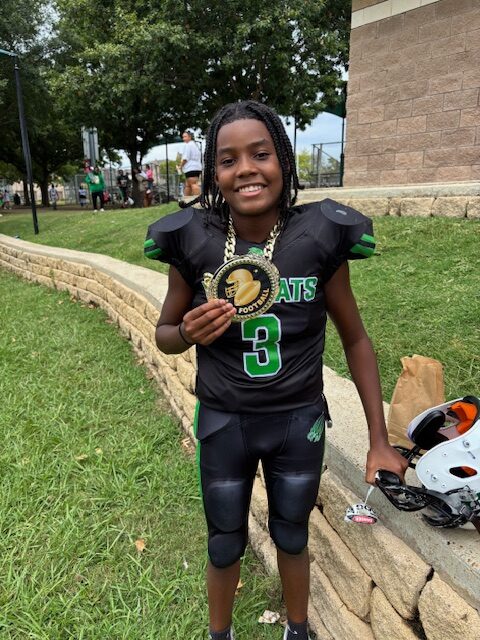
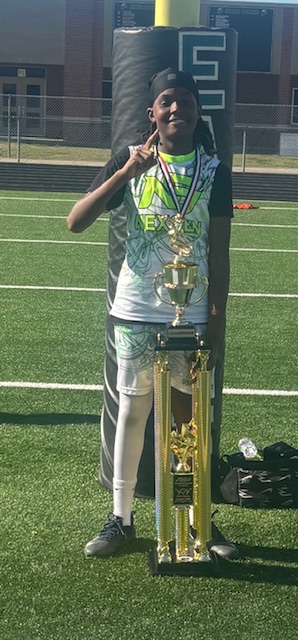
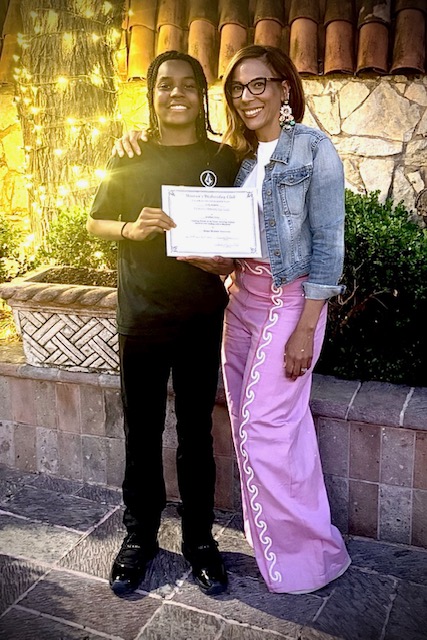
Dedication: Thank you to A and my husband for allowing me to access your words and worlds. Our paths are not easy, but we proceed anyway. ATF! Also can’t forget to shout out Derrick Henry for modeling all the ways to stiff arm!
References
Barnes Daniel, Riche J. Raising the Race: Black Career Women Redefine Marriage, Motherhood, and Community. Rutgers University Press, 2016.
Bopp, Trevor, and Robert Turick. “An Analysis of Racial Tasking and Other Sport Management Theories through the Lived Experiences of Black College Football Coaches.” Journal of Issues in Intercollegiate Athletics 17, no. 1 (2024): 218 — 40. https://doi.org/10.51221/sc.jiia.2024.17.1.11
Browdy, Ronisha. “Black Women’s Rhetoric(s): A Conversation Starter for Naming and Claiming a Field of Study.” Peitho 23, no 4, Summer 2021.
Bryan, Nathaniel. Toward a BlackBoyCrit Pedagogy: Black Boys, Male Teachers, and Early Childhood Classroom Practices. Routledge, 2021.
Caldwell, Brandon. “Texas State Trooper relieved of game-day duties after aggressively bumping Black South Carolina players during Texas A&M Game.” MS, December 2025, https://www.msn.com/en-us/sports/general/texas-state-trooper-relieved-of-game-day-duties-after-aggressively-bumping-black-south-carolina-players-during-texas-a-m-game/ar-AA1QvWYS?ocid=BingNewsSerp.
Canada, Tracie. Tackling the Everyday: Race and Nation in Big-Time College Football. University of California Press, 2025.
Carr, Nicole. Black Feminist Mothering in 21st-Century Literature: I Am Not Your Mammy. Routledge, 2025.
Collins, Patricia Hill. Black Feminist Thought: Knowledge, Consciousness, and the Politics of Empowerment. Taylor & Francis, 2022.
Dancyger, Lilly. “Eclipse,” Brevity (blog), January 30, 2024, https://brevity.wordpress.com/2024/01/30/eclipse/.
Franklin, Kelly. “Baa, Baa, Black Sheep, Where My Dawgs At? Implementing an Anti-Racist Pedagogy as a Literacy Specialist with Student Athletes.” English Teaching: Practice & Critique 6, 2025.
Franklin, Kelly. “For the Culture Pedagogy: I’m Starting with the Woman in the Mirror.” Writers: Craft & Context 6, no. 1 (2025): 20–25.
Franklin, Kelly, and Randy Reese. “Relaxing in the Margins: Using Black Feminist Pedagogy with Black Student-Athletes to Challenge AI Compliance and Protect Black Voices in First-Year Writing.” Peitho 28, no. 1 (2025): 27-40.
hooks, bell. All About Love: New Visions. William Morrow, 2001.
hooks, bell. The Will to Change: Men, Masculinity, and Love. Washington Square Press, 2025.
Kurup, Sahil. “Police confirm tragic details around Rondale Moore death after text to NFL star.” The Mirror, February 21, 2026. https://www.themirror.com/sport/american-football/rondale-moore-cause-death-nfl-1697719.
Kynard, Carmen. Vernacular Insurrections: Race, Black Protest, and the New Century in Composition-Literacy Studies. SUNY Press, 2013.
“Kyren Lacy’s Mom Emotional After Players Honor Son…’I Watched in Tears.’” TMZ, September 5, 2025. https://www.tmz.com/2025/09/06/kyren-lacy-malik-nabers-treydez-green-tribute-mom-lsu-nfl/.
Mitchell, Koritha. “Identifying White Mediocrity and Know-Your-Place Aggression: A Form of Self-Care.” African American Review 51, no. 5 (2018): 253–62.
Morrison, Toni. Beloved. First Vintage International Edition, 2004.
Muhammad, Gholdy. Cultivating Genius: An Equity Framework for Culturally and Historically Responsive Literacy. Scholastic, 2020.
Muhammad, Gholdy. Unearthing Joy: A Guide to Culturally and Historically Responsive Teaching and Learning. Scholastic, 2023.
Perry, Imani. Breathe A Letter to my Sons. Beacon Press, 2019.
Royster, Jacqueline Jones. Traces of a Stream: Literacy and Social Change among African American Women. University of Pittsburgh Press, 2000.
Suggs, David. “Marshawn Kneeland death details: What we know about Cowboys DE’s sudden passing.” The Sporting News, November 23, 2025. https://www.sportingnews.com/us/nfl/news/marshawn-kneeland-death-details-cowboys/d4a22931aa8f7d5c54bc88a6.
Walker, Alice. In Search of our Mothers’ Gardens. Harcourt Inc., 1983.
Notes
- David Suggs, “Marshawn Kneeland death details: What we know about Cowboys DE’s sudden passing,” The Sporting News, November 23, 2025, https://www.sportingnews.com/us/nfl/news/marshawn-kneeland-death-details-cowboys/d4a22931aa8f7d5c54bc88a6. ↩︎
- Sahil Kurup, “Police confirm tragic details around Rondale Moore death after text to NFL star,” The Mirror, February 21, 2026, https://www.themirror.com/sport/american-football/rondale-moore-cause-death-nfl-1697719. ↩︎
- Lilly Dancyger, “Eclipse,” Brevity (blog), January 30, 2024, https://brevity.wordpress.com/2024/01/30/eclipse/. ↩︎
- Dancyger, “Eclipse.” ↩︎
- In football discourse, “trucking” means running over a defenderwith power, usually by dropping the shoulders and hips, being strong and aggressive, and keeping the head up. Although any ball carrier can truck, this tactic is often executed by running backs. (https://www.prettymotors.com/what-does-it-mean-to-truck-someone-in-football/) ↩︎
- Imani Perry, Breathe A Letter to my Sons (Boston: Peacon Press, 2019), 18. ↩︎
- Nicole Carr, Black Feminist Mothering in 21st-Century Literature: I Am Not Your Mammy (New York: Routledge, 2025), 2. ↩︎
- TMZ Staff. “Kyren Lacy’s Mom Emotional After Players Honor Son…’I Watched in Tears.’” https://www.tmz.com/2025/09/06/kyren-lacy-malik-nabers-treydez-green-tribute-mom-lsu-nfl/(October 2025) ↩︎
- Audre Lorde, Sister Outsider (Berkeley: Crossing Press, 2007), 43. ↩︎
- Brandon Caldwell, “Texas State Trooper relieved of game-day duties after aggressively bumping Black South Carolina players during Texas A&M game,” MSN December, 2025, https://www.msn.com/en-us/sports/general/texas-state-trooper-relieved-of-game-day-duties-after-aggressively-bumping-black-south-carolina-players-during-texas-a-m-game/ar-AA1QvWYS?ocid=BingNewsSerp ↩︎
- Koritha Mitchell, “Identifying White Mediocrity and Know-Your-Place Aggression: A Form of Self-Care,” African American Review 51, no. 5 (2018): 253–62. ↩︎
- Author’s son, personal journal entry, October 7, 2025. ↩︎
- Carmen Kynard, Vernacular Insurrections: Race, Black Protest, and the New Century in Composition-Literacy Studies. (New York: SUNY Press, 2013), 18. ↩︎
- Gholdy Muhammad, Unearthing Joy: A Guide to Culturally and Historically Responsive Teaching and Learning (New York: Scholastic, 2023) 36. ↩︎
- Kelly Franklin and Randy Reese, “Relaxing in the Margins: Using Black Feminist Pedagogy with Black Student-Athletes to Challenge AI Compliance and Protect Black Voices in First-Year Writing,” Peitho 28, no. 1, Fall 2025. ↩︎
- Toni Morrison, Beloved (New York: First Vintage International Edition, 2004), 184. ↩︎
- bell hooks, The Will to Change: Men, Masculinity, and Love (New York: Washington Square Press, 2025), 16. ↩︎
- At the time of this writing, the author is still writing her dissertation to define Black Football Feminism. However, for the sake of this reference, a Black Football Feminist is loosely defined as anyone in the college football apparatus who can critique the system using feminist and womanism praxis with an understanding that Black women remain valuable contributors in this enterprise. From rural women in the South to academics, Black women are part of college football’s commercial value and must be acknowledged. ↩︎
- Kelly Franklin, “Baa, Baa, Black Sheep, Where my Dawgs at?” Implementing an Anti-Racist Pedagogy as a Literacy Specialist with Student Athletes.” English Teaching: Practice & Critique,November 2025. ↩︎
- Kelly Franklin and Randy Reece, “Relaxing in the Margins: Using Black Feminist Pedagogy with Black Student‑Athletes to Challenge AI Compliance and Protect Black Voices in First-Year Writing,” Peitho 28, no 1 (2025). ↩︎
- Kelly Franklin, “For the Culture Pedagogy: I’m Starting with the Woman in the Mirror,” Writers Craft and Context 6, no. 1, (2025). ↩︎
- Kelly Franklin, “Poppin’ Off at the Mouth: Reimagining First Year Writing Classes for Black Student Athletes and Black Graduate Students”—Forthcoming ↩︎
- Nathaniel Bryan, Towards a BlackBoyCrit Pedagogy: Black Boys, Male Teachers, and Early Childhood Classroom Practices (New York: Routledge, 2021), p 125. ↩︎
- Trevor Bopp and Robert Turick, “An Analysis of Racial Tasking and Other Sport Management Theories through the Lived Experiences of Black College Football Coaches,” Journal of Issues in Intercollegiate Athletics 17, no. 1 (2024): 218–40. https://doi.org/10.51221/sc.jiia.2024.17.1.11 ↩︎
- Franklin and Reece, “Relaxing in the Margins”. ↩︎
- Canada,, 118-119. ↩︎
- Riche J. Barnes Daniel, Raising the Race: Black Career Women Redefine Marriage, Motherhood, and Community (New Brunswick, New Jersey and London: Rutgers University Press, 2016), 3. ↩︎
- Patricia Hill Collins, Black Feminist Thought: Knowledge, Consciousness, and the Politics of Empowerment (New York: Taylor & Francis, 2022), 247. ↩︎
- Bryan, 106. ↩︎
- Muhammad, Cultivating Genius: An Equity Framework for Culturally and Historically Responsive Literacy, 106. ↩︎
- Jacqueline Jones Royster, Traces of a Stream: Literacy and Social Change Among African American Women (Pittsburgh: University of Pittsburgh Press, 2000) 30. ↩︎
- Alice Walker, In Search of our Mothers’ Gardens (New York: Harcourt Inc., 1983) xi. ↩︎
- This is referencing the recent scandal of former head coach at the University of Michigan, Sherrone Moore, whose extramarital affair with a young, white staff member became public information and called his code of conduct into question. Moore’s behavior was erratic after being fired by the university and he allegedly went to his mistress’ home and threatened to take his life. These actions led to his arrest with prosecutors charging Moore with felony third-degree home invasion and two misdemeanors: stalking in a domestic relationship and breaking and entering. This story is still developing at the time of my writing. ↩︎
- bell hooks, All About Love; New Visions (New York: William Morrow, 2001) 37-39. ↩︎
- Black Football Feminist is an expansive framework that invites all bodies into this work, particularly those who are committed to an ethical stance that refuses to push Black women to the perimeters of the football field and disregard their labor. A Black football feminist framework is not just limited to women and opens broader conversations about football in the same spirit Joan Morgan used to expand hip hop conversations. ↩︎
- Canada, 119. ↩︎
- Ronisha Browdy. “Black Women’s Rhetoric(s): A Conversation Starter for Naming and Claiming a Field of Study,” Peitho 23, no 4 (2021) 3. ↩︎
- hooks, All About Love; New Visions, 53. ↩︎
- Franklin, “Baa, Baa, Black Sheep, Where My Dawgs At?” ↩︎