
Present
When my daughter is four, I return to the town where she was born. I return for an ending. I return for a ceremony. As we drive, I am all pointy fingers—”there’s the green house, the striped hammock, the duck pond.” My body remembers humidity as my daughter squints beyond my fingertips. She nods. Shakes her head. Am I confusing her? I fear I am asking too much of her and of this ceremony. But I crave ceremony: a laundry line to hang the pieces of my years. I am here now because, two years ago, my graduation ceremony was cancelled. The pandemic had begun to rage. Now, I worry too much time has passed. I am no longer a graduate student. In fact, I am already leaving my first professor job. But this ceremony still matters to me, because regardless of a job or a title, there can still be a ceremony.
When I arrive at my graduate school, my daughter, my husband, and I step into a crowded elevator. I feel awkward and fold myself into the corner. My eyes catch a man’s crisp collared shirt—so close I could bite the cuff. I feel my neck hot with embarrassment. I am ashamed of my desire for a regal costume and communal stepping of feet. It all feels like more than I should require. In this very building, I poured over books about the complex relationship between writers’ lived experience and the writing they produce1 (Vieira et al. 2023). And I hate to admit it, but my relationship with literacy has become more complicated since I became a mother. My experience of literacy is now too often laced with shame. It is milk leaked onto papers, books and computers stacked on playground benches. It is attention and care doubled and divided both. Amidst mothering, writing feels unreal and even fraudulent.2 But it also feels like something of my own. Writer, Miriam Toews (2025), calls this writing the work of “stolen moments3“—ie. moments stolen from my daughter I assume. To ease my shame, I try frantically to erase the edges of the messy intersection between motherhood and literacy work: sopping up the milk and tightening my elbows around the computer screen.
But in the elevator, headed to my graduation, I feel myself erupt from the edges until I spill over, a pile of need. I need the ceremony to answer questions it cannot: Is my work good enough to merit such theft? Will a ceremony make the stolen moments, the uprooting of my child, alright? I want my child to validate what I have stolen from my writing and my writing to validate what I have stolen from my child.
I share this story not to make a case for mothering as a form of literacy work. Rather I seek to recognize how, when defined as work, mothering provides insight into broader systems of oppression that diminish both literacy and caretaking for people who mother. Following many others who have highlighted the overlapping experience of literacy and care work,4 I long to transform moments “stolen” into those supported and celebrated in material ways. I see ceremony, a ritualized community celebration, as one way to recognize the embodied and collective labor that are both mothering and literacy work.
As I open the doors to the ceremony, caretaking duties continue to compete for space in my body: Did I pack enough snacks? What if my daughter runs through the halls? What if we cause a scene? Did I do enough to earn this moment? I notice people noticing me—how it takes a minute for others to place me—a reminder that this is no longer my place. I raise my hand sheepishly. “Hello.” Despite their friendly gestures, I feel inappropriate. It is a mistake, I think, to have come. I glance back at my daughter in her blue paisley dress. The ties at the top of her shoulders meet her bright blue mask, reminding me I risk something by bringing her here—that perhaps I am choosing work over her again. She is finally vaccinated, but the pandemic continues. It would be a lie to say I am doing this for her. It is I who ache for her to know my work has amounted to something worth celebrating.
The graduates are told to rise.
Past
When I attended my PhD program’s graduation ceremony for the first time, I did not expect to feel anything. But as soon as the graduates began telling their stories, I realized I was unprepared. I had no tissues, so I cried into my empty hands. This was not a standard graduation. Each graduate was introduced by a mentor before speaking to a room of peers and teachers, family and friends. I listened as graduates shook the context from their pages and said thank you to all those who helped their writing come to be. With drenched palms, I watched a graduating mother’s pregnant belly vibrate with each word that rose from her lungs to the air.
I was so struck by the way the ceremony uniquely challenged academic myths of single-authorship. The embodied5 (Anzaldúa 1983; Haas and Witte 2001; Prior and Shipka 2003; Cedillo 2018; Miller 2022) presence of the writer and their social6 and material7 (Vieira 2016) relations disrupted the myth of the lone, self-sufficient (white, male, able-bodied) writer—a myth that persists despite dominant understandings in the field of literacy. As Kate Vieira writes in “Field Work with A Five Year Old8” (2018), it has become an assumption of literacy studies that the context of writing matters: “the social, historical, and geographic conditions of its production”: “the relationships, time, and space” (17). This ceremony mattered to me because it allowed graduates to share their literacy narratives9 which so moved the context to the center—the context that is collective care.
Soon after I attended that first ceremony, my husband and I decided to have a child. I approached my pregnancy like course work, planning goals and appointments in columns on the wall. This planning was necessary because, at the time, a graduate student’s maternity leave was seven paid days—the result of a long graduate student union fight. But despite this institutional neglect, people in my program made me feel cared for. My advisor and her daughter chose soft gray sheets and a stuffed animal with matching gray fur. Another mentor waited until we chose a name to hand me signed books from a famous local author. And, one day, my mentor with yellow hair asked, “How are you?” When I said we had a good doctor’s appointment. She replied, “I do not just mean the baby. How are you?” Ah me, I thought, yes, I am not just the baby living inside of me. She set two bags overflowing with supplies at my feet. Later, at the ceremony, she would crouch on the floor and sing my daughter a dinosaur song.
The summer my daughter was born, my husband and I calculated how we could live off his salary and my exams stipend. Gratefully, I had this time to learn how to take care of my child. And there was still too much to learn. I was overwhelmed by car seats, strollers, feeding, and swaddling. So much seemed necessary simply to keep her alive. To paraphrase Nancy Reddy10, I felt entirely inadequate and wondered if I had ever known anything before. I craved the writing I once knew: to sit down at a desk and feel my fingers working ideas out on the page. As I woke, held, fed, and strolled my child, I generated arguments for my dissertation and spoke them to my daughter’s toes and the passing trees.
But I struggled to think about my work—both the writing and the care—as work. As I have written elsewhere, during my pregnancy, I researched with people employed as university custodial staff, some of whom were also pregnant. I was wary of too closely aligning academic labor to racialized working-class positions without accounting for the extent to which those positions were devalued and restricted in terms of literacy. For example, I wrote freely on my university-sponsored computer while custodians were questioned and surveilled around writing—whether they were posting signs for their job or using a computer on a break.11 Although I understood all university labor systems were connected, I doubted that complaining about my labor rights as an upper-class white graduate student would benefit the people I was researching with.
But I also struggled to consider my caretaking as work because, at least in US culture, care work is rarely acknowledged as work. Writer Angela Garbes explains, “American society values work in how much we produce, and how efficiently we can do it. It tells us that our output is our worth.”12 Care work challenges capitalist values around production because it is inefficient and unending. It is slow, tedious yet unpredictable, difficult to quantify, and necessarily collaborative. For all these reasons, under capitalism and the white supremacy culture that praise the urgent, quantifiable, individualistic labor, mothering is neither read as productive nor valuable.13
And within the specific context of the neoliberal university, caretaking and writing are understood to be diametrically opposed. Care is seen as detracting from writing and writing is seen as detracting from care. But this is where, within such oppressive systems, care work and writing intersect and illuminate one another. Very much like literacy, care work requires collaboration and community, but is constantly alienated to private, individual realms. Much like my writing work, my work as a mother felt illegitimate and entirely my individual responsibility. And these dual positions, as illegitimate and responsible worker, ultimately reinforced privatizing individual work which made me feel unworthy of asking for support.14
The first day I took my daughter to daycare so that I could teach, I felt ready and relieved. But the relief immediately made me feel guilty. As I taught, I worried. I didn’t know whether I should look at my phone. I couldn’t think. I clutched a syllabus to hide the milk I feared leaking through my shirt. Then I ran to my shared office to pump instead of to write. I cried over emails that asked me to do things. I couldn’t produce what I should or what I wanted. I wish I had known Angela Garbes’ work and how she reframes caregiving’s value: “If we were to think about work in terms of our humanity—making people feel dignified, valued and whole—then caregiving is the most important work we can do with our time on earth.”15 I longed to be valued for the things I was doing—for my care and literacy work to compliment rather than compete.
But the competition continued. When it was time to travel to a conference, I busied myself by producing the value that I could. I stockpiled breast milk. Because I live within capitalist understandings of transaction, I knew that leaving meant debt—that I would pay a price for my desires to write. So, after work, work continued. I pumped hundreds of ounces as a price for leaving.16 I raced to pick up my daughter. I jogged to the door to find my child bouncing contentedly in a swing. Sometimes the incredible woman who cared for her rested her in the trunk of a tree. Sometimes my daughter cried when she saw me. I thought this was my punishment for the choices I had made.
At night, I fed my daughter on one side and pumped on the other. Double to make my quota. I set my alarm to wake after feeding to use the machine. No one made me do this—no one needed to. I knew what I was supposed to do. I did not want to leave my child, but I did not want her at school or conferences with me. I could not talk and think and write with her present. But she was never really gone. As I leaked and woke and pumped and worried, I could not forget that my body carried her needs.
At school, when students rushed out the door, I scurried back to an office to pump back-to-back with a colleague. I was ashamed that I could not find the courage to ask for breaks—when my body began to swell and fill and spill—but I didn’t want to talk about my breasts at work. I didn’t want to put a sign on the door. I wanted to disown my body and the lunchbox filled with milk contraptions in the shared fridge. And I was most ashamed when I saw a breastfeeding colleague in a single office. Because I had never thought to ask, and it was not offered to me.
Still, I clung to the presence of mothering professors and students—including those who didn’t have children but mothered just the same. These mothering folks held papers and bodies covered in liquids and crayon. They bought coffee, made meals, shared articles and stories, and told me it was okay to put away my phone. This work is characteristic of how, drawing from Alexis Pauline Gumbs’s, China Martens’s, and Mai’a Willaims’s (2016) Revolutionary Mothering,17 Angela Garbes explains mothering, a verb not dependent on gender with implications for all,
The terrain of mothering is not limited to the people who give birth to children; it is not defined by gender…Rather than viewing care work as characteristic of the noun, motherhood I now see it as the action of mothering, which includes anyone who is engaged in the practice of ‘creating, nurturing, affirming and supporting life.’18
This nurturing was visible in the way we shared white onesies, glass bottles, and chew toys—the way we dropped the objects at doors and on porches in library totes and garbage bags, passing love along materially. We were not always friends exactly, but we were something important and necessary to each other—something that allowed me to do my work.
We mothered as we conspired on the phone about due dates and early arrivals that interfered with job markets and job visits. When I talked to mothers who interviewed for jobs just days after giving birth, I was so angry my knuckles shook. But I had no better option to offer them. So, we strategized. We negotiated our mother-writer-teacher bodies by brainstorming: What can we ask for? How much should we reveal? A virtual visit? A mask? A chair? A meal? A break? Can we want more than is offered? Can we want more than what is? We had no answers, but we asked these questions together, and it was better than doing it alone.
Future
A year after my graduation, I climb into my daughter’s bed to read the book, Tar Beach by artist Faith Ringold.19 In the illustrations, we see the narrator, a young black girl, arms outstretched over rooftops, feet touching stars. She flies over spaces from which she and her family are excluded to make them hers. She flies to make her dreams manifest. In the classroom, I similarly ask students to dream of futures where everyone can get what they need. We read and listen to Black Feminists,20 Disability Justice Theorists,21 poets,22 and scholars of “radical imagination”23 who tell us to want more than what is. In the words of Sonya Renee Taylor, we are always living in someone’s imagination. So, why not imagine a better way?24
I begin to take speculative writing classes.25 In one, the instructor speaks through long dark hair: “Write by hand,” she says, “talk gently to yourself—your bodies are listening.” Then “Write what happened, what could have happened, and what should have happened instead.” Slowly, I release the questions: How might literacy be celebrated and cared for materially in the context of mothering? I think it is worth trying to imagine. So, I turn the page and write my dreams:
At the ceremony, we mothering-graduates open our mouths to find we cannot speak. Our tongues grasp air, the words that are our vocation. But words are missing. Did we use them all? In our chapters? In our lessons? In our lullabies? We open our mouths to find only sound. A gasp, a grunt, a scream, a melody. This scares us at first. But as we look out at the audience and their wondering faces, we look at each other again. We are no longer embarrassed, doubtful, ashamed. We listen to the silence rich and deep. We let it hold us. The audience stifles a breath. No one knows what will come.
Then all at once, we turn to one another, realizing we cannot tell our experience alone. Our bodies know what to do, and we listen to them. Without speaking, we trade papers from hand to hand. They rustle until a gentle echo coats the room. A vibration rises from our writing, from our exchange. Then we begin, one at a time, to speak each other’s words, each other’s stories. We are joined by mentors who step into the circle, leaning on shoulders and elbows and hips.
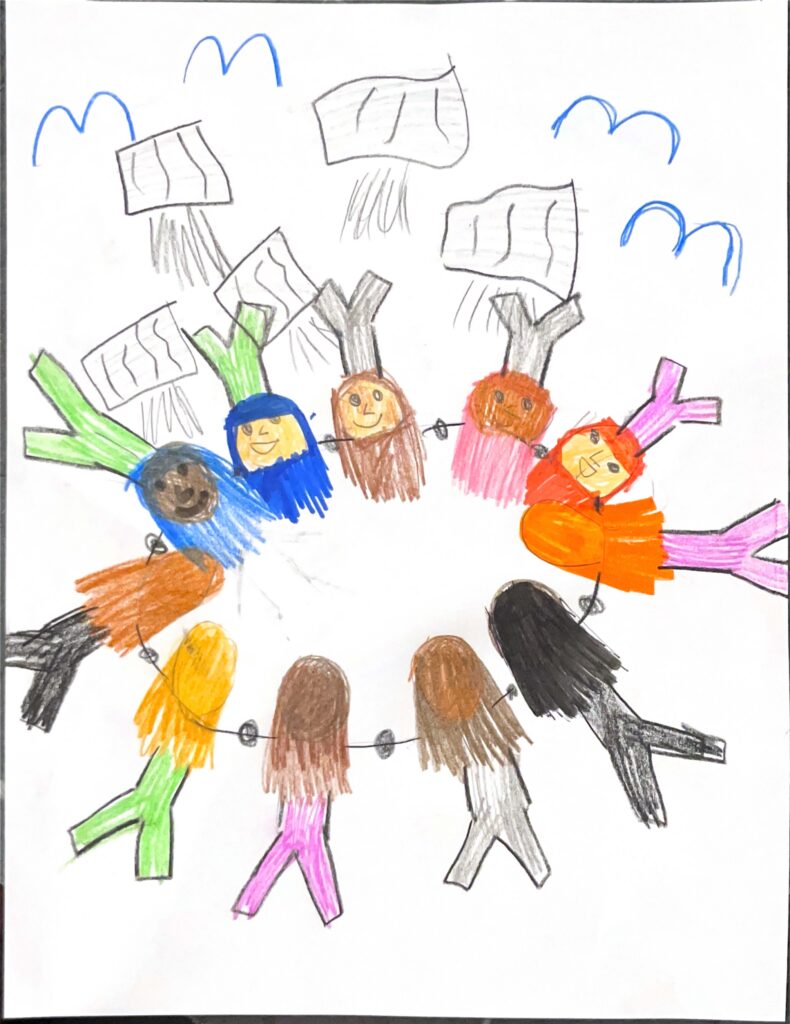
And when the last person breathes their final word, we release the pages at our feet. I hear a swish as the papers quickly rise and circle us. They whirl around our embraced hands, a tornado. Caught in its current, we rise above the crowd together, floating. We look down on the audience’s bobbing heads. The tornado will not crush us. The current lifts us up and carries us high above.
I see my daughter’s blue paisley dress. She throws back her head and looks up at me, at us. She smiles. She waves. As if she expected this—for me to rise above her like a balloon. I gaze at her shoulders, the tiny blue ties. I think that, even more than the costume, the degree, I am happy for her to witness this circle—this exchanging and voicing of one another’s words. This embrace.26
We rise through the ceiling, blooming into the clouds. I try to hold a cloud in my hand, but the air streams through my fingers and makes me giggle. We pass birds who do not turn their heads. They recognize our coordinated movement, the way our wingspan stretches and adjusts for one another’s body, the way we maintain our circle as we move. The birds know ceremony.
As we fly, we remove pens from pockets and wave them in the air like wands. Over the houses in town, those that house parents and caretakers and mothering folks. With the wave of our pens, we write into the world that caregivers will be paid for labors of all kinds. We write that they will be prioritized and valued. For the feeding, the nursing, the bathing, and the comforting, the temperature-taking, and multitasking and managing for the future and all our greater good. “You will be paid, you will be compensated, you will be valued for these labors,” together we chant.
Then, as if by an invisible string, we softly drop into an open patch of grass. With our feet in the dirt up to our ankles, we ask the land about our silent plans. With a nod from the earth, we begin to create the spaces that we need, the structures of our dreams. Our arms rise and harden into stone and sturdy brick. Our hair weaves into thatched roofs. Our collar bones become vaulted ceilings. Our eyes windows, lashes curtains around the rims. Flowered arches form behind our knees. We make solid welcoming spaces, an entrance filled with color like a bowl of fruit. We lean down and carve the names of mothering folks into the floor, ensuring that we leave space for more.
We make something that cannot be taken from us. We make more than we have been given. As we step out from the walls and admire our work, a woman steps forward. She brushes the dirt from her patterned dress, flowers still dripping from her knees. Her voice is loud and clear. She is not afraid. She declares that this space will provide free childcare to all university employees and community members. The caretakers who work there will receive the same and a living, thriving wage. This will be a place to visit, to learn, to grow, and to play for those caring and cared for both. Because we are here to celebrate labor born of bodies and interdependent care. May we never forget that nobody does this work alone.
Acknowledgements
Thank you to The Sandbox team, Gabrielle Keleyni, Debbie Mitchell, Ella and Ryan Hall, Fernanda Leporace, and all my graduate school mentors and peers.
Bibliography
Anzaldúa, Gloria. Borderlands/La Frontera. Aunt Lute, 1987.
Birdsong, Mia. How We Show Up: Reclaiming Family, Friendship, and Community. Hachette Books, 2020.
Aloziem, Ozy and Bobby Lefebre. “Radical Imagination.” Keynote, Community Writing Conference. Denver, 2023.
Fletcher, Harrison. “Truth The Whole Truth and Nothing but Speculation.” Nonfiction Fest, Lighthouse Writers Workshop, Fall 2024.
Dederer, Claire. Monsters. Penguin Random House, 2023.
Garbes, Angela. Essential Labor: Mothering as Social Change. Harper Collins, 2022.
Gumbs, Alexis Pauline, China Martens, Mai’a Williams, eds. Revolutionary Mothering: Love on the Frontlines. PM Press, 2016.
Gutiérrez, Kris D. “Developing a Sociocritical Literacy in the Third Space.” Reading Research Quarterly 43, no. 2 (2008): 148–64.
Haas, Christina, and Stephen P. Witte. “Writing as Embodied Practice: The Case of Engineering Standards.” Journal of Business and Technical Communication 15, no. 4 (2001): 413-457.
Hanson, Alex. “Career Killer Survival Kit: Centering Single Mom Perspectives in Composition and Rhetoric.” Composition Studies 48, no 1. (2020): 35-52.
Imarisha, Walidah and adrienne maree brown, eds. Octavia’s Brood: Science Fiction Stories. from Social Justice Movements. AK Press, 2023.
Martinez, Aja Y. “On Our Path, Me and my Libby.” Chicana M(other)work, 2019. www.chicanamotherwork.com/single-post/2019/05/03/On-Our-Path-Me-and-my Libby.
Marotta, Calley. “Nonregulated Writing: A Qualitative Study of University Custodial Staff Literacies.” Research in the Teaching of English 55 no. 3 (2021): 289-310.
Miller, Elisabeth. What It Means to Be Literate: A Disability Materiality Approach to Literacy after Aphasia. University of Pittsburgh Press, 2022.
“Miriam Toews on Confronting Silence.” Thresholds. September 17, 2025, Podcast, https://podcasts.apple.com/us/podcast/thresholds/id1501963287
Nelson, Maggie. Bluets. Wave Books, 2009.
Okun, Tema. White Supremacy Culture, first published 2021, updated 2025. https://www.whitesupremacyculture.info/
Osorio, Ruth, Vyshali Manivannan, Jessie Male, eds. Multimodal Rhetorics Special Issue on Carework 6 no. 2 (2022).
Piepzna-Samarasinha, Leah Lakshmi. Care Work: Dreaming Disability Justice. Arsenal Pulp Press, 2018.
Powell, Malea. “Stories Take Place: A Performance in One Act” (chair’s address). College Composition and Communication 64 no 2 (2012): 383–406.
Prior, Paul, and Jody Shipka. “Chronotopic Lamination: Tracing the Contours of Literate Activity.” In Writing Selves, Writing Societies, ed. Charles Bazerman and David R. Russell, 180–238. WAC Clearinghouse and Mind, Culture, and Activity, 2003.
Elise Lohen and Maggie Smith, “Reconceiving our Lives (Maggie Smith.)” Produced by Lemonada. Pulling the Thread with Elise Lohen. April 13, 2023,Podcast. https://podcasts.apple.com/us/podcast/reconceiving-our-lives-maggie-smith/id1585015034?i=1000608745237
Reddy, Nancy. The Good Mother Myth: Unlearning Our Bad Ideas About How to Be a Good Mom. Macmillan Publishers, 2025.
Ringold, Faith. Tar Beach. Crown Publishers, 1991.
Ruhl, Sarah. 100 Essays I Don’t Have Time to Write: On Umbrellas and Sword Fights, Parades and Dogs, Fire Alarms, Children and Theater. Farrar, Straus and Giroux, 2015.
Street, Brian V. Literacy in Theory and Practice. Cambridge University Press, 1984.
Shantz, Sarah Elizabeth. “Writing Around the Periphery of the Wound.” Lighthouse Writers Workshop, Winter 2023.
Wambach, Abby, Amanda Doyle, Glennon Doyle, and Sonya Renee Taylor, “Sonya Renee Taylor: What if You Loved Your Body?” We Can Do Hard Things. Apple, 11 Jan 2023, https://podcasts.apple.com/us/podcast/168-sonya-renee-taylor-what-if-you-loved-your-body/id1564530722?i=1000593882497
Vieira, Kate. American by Paper: How Documents Matter in Immigrant Literacy. University of Minnesota Press, 2016.
Vieira, Kate. “Fieldwork with a Five Year Old: A Summative Report,” Writing on the Edge. (2018): 1-27. https://woejournal.ucdavis.edu/sites/g/files/dgvnsk15586/files/media/documents/Fieldwork%20with%20a%20Five-Year-Old.pdf
Vieira, Kate, Lauren Heap, Sandra Descourtis, et al. “Literacy is a Socio-Historic Phenomenon that can Liberate and can Oppress.” In (Re)Considering What we Know: Learning Thresholds in Writing, Composition, Rhetoric, and Literacy, edited by Elizabeth Wardle and Linda Adler-Kassner. Utah State University Press, 2020.
Young, Anna M., ed. Teacher, Scholar, Mother: Re-Envisioning Motherhood in the Academy. Lexington Books, 2015.
Footnotes
- Kate Vieira et al., “Literacy is a Socio-Historic Phenomenon that can Liberate and can Oppress” in (Re)Considering What we Know: Learning Thresholds in Writing, Composition, Rhetoric, and Literacy, ed. Elizabeth Wardle and Linda Adler-Kassner Logan: (Utah State University Press, 2020). ↩︎
- See Sarah Ruhl, 100 Essays I Don’t Have Time to Write: On Umbrellas and Sword Fights, Parades and Dogs, Fire Alarms, Children and Theater. (New York: Farrar, Straus and Giroux, 2015); Claire Dederer, Monsters. (Penguin Random House, 2023); Elise Lohen and Maggie Smith, “Reconceiving our Lives (Maggie Smith),” April 13, 2023, in Pulling the Thread with Elise Lohen. Produced by Lemonada, podcast, MP3 audio, https://podcasts.apple.com/us/podcast/reconceiving-our-lives-maggie-smith/id1585015034?i=1000608745237. ↩︎
- Jordan Kisner and Miriam Toews “Miriam Toews on Confronting Silence,” September 17, 2025, in Thresholds. Co-produced by Black Mountain Institute and Literary Hub, podcast, MP3 audio, https://podcasts.apple.com/us/podcast/thresholds/id1501963287. ↩︎
- Kate Vieira, “Fieldwork with a Five Year Old: A Summative Report,” Writing on the Edge (2018): 1-27; Aja Y. Martinez, “On Our Path, Me and my Libby,” Chicana M(other)work, 3 May 2019, chicanamotherwork.wixsite.com/mysite/single-post/2019/05/03/on-our-path-me-and-my-libby; Alex Hanson, “Career Killer Survival Kit: Centering Single Mom Perspectives in Composition and Rhetoric.” Composition Studies 48, no 1. (2020): 35-52; Ruth Osorio, Vyshali Manivannan, Jessie Male, eds. Multimodal Rhetorics Special Issue on Carework 6 no. 2 (2022). ; Nancy Reddy, The Good Mother Myth: Unlearning Our Bad Ideas About How to Be a Good Mom (Macmillan Publishers 2025). ↩︎
- See Gloria Anzaldúa, Borderlands/La Frontera (Aunt Lute Books, 1987); Christina Haas and Stephen P. Witte, “Writing as Embodied Practice: The Case of Engineering Standards,” Journal of Buisness and Technical Communication 15, no. 4 (2001): 413 – 457; Paul Prior and Jody Shipka, “Chronotopic Lamination: Tracing the Contours of Literate Activity,” in Writing Selves, Writing Societies, ed. Charles Bazerman and David R. Russell (WAC Clearinghouse and Mind, Culture, and Activity, 2003), 180 – 238; Elisabeth Miller, What It Means to Be Literate: A Disability Materiality Approach to Literacy after Aphasia (University of Pittsburgh Press, 2022); ↩︎
- Brian Street, Literacy in Theory and Practice (New York: Cambridge University Press, 1984); Kris Gutiérrez, “Developing a Sociocritical Literacy in the Third Space,” Reading Research Quarterly 43, no. 2 (2008): 148–64. ↩︎
- Kate Vieira, American by Paper: How Documents Matter in Immigrant Literacy (University of Minnesota Press, 2016). ↩︎
- Kate Vieira, “Fieldwork with a Five Year Old: A Summative Report,” Writing on the Edge (2018): 1-27. ↩︎
- Malea Powell, “Stories Take Place: A Performance in One Act” (chair’s address). College Composition and Communication 64 no 2 (2012): 383–406. ↩︎
- Reddy, The Good Mother Myth, 1. ↩︎
- Calley Marotta, “Nonregulated Writing: A Qualitative Study of University Custodial Staff Literacies.” Research in the Teaching of English 55 no. 3 (2021): 289-310. ↩︎
- Angela Garbes, Essential Labor: Mothering as Social Change (Harper Collins, 2022). ↩︎
- Tema Okun, White Supremacy Culture, first published 2021, updated 2025. www.whitesupremacyculture.info/ ↩︎
- Reddy, The Good Mother Myth, 63, 76, 172. ↩︎
- Angela Garbes Essential Labor: Mothering as Social Change (Harper Collins, 2022), 10. ↩︎
- Sarah Ruhl, 100 Essays I Don’t Have Time to Write: On Umbrellas and Sword Fights, Parades and Dogs, Fire Alarms, Children and Theater (Farrar, Straus and Giroux, 2015), 78. ↩︎
- Alexis Pauline Gumbs et. al, eds. Revolutionary Mothering: Love on the Frontlines. ( PM Press, 2016). ↩︎
- Angela Garbes, Essential Labor: Mothering as Social Change (Harper Collins, 2022), 9. ↩︎
- Faith Ringold, Tar Beach (Crown Publishers, 1991). ↩︎
- Walidah Imarisha, and adrienne maree brown, eds. Octavia’s Brood: Science Fiction Stories. from Social Justice Movements (CAK Press, 2023). ↩︎
- Leah Lakshmi Piepzna-Samarasinha, Care Work: Dreaming Disability Justice (Arsenal Pulp Press, 2018). ↩︎
- Maggie Nelson, Bluets (Wave Books, 2009). ↩︎
- Ozy Aloziem and Bobby Lefebre, “Radical Imagination” (Keynote, Community Writing Conference. Denver, 2023). ↩︎
- “Sonya Renee Taylor: What if You Loved Your Body?” January 11, 2023, in We Can Do Hard Things, podcast. https://podcasts.apple.com/us/podcast/168-sonya-renee-taylor-what-if-you-loved-your-body/id1564530722?i=1000593882497 ↩︎
- See Sarah Elizabeth Shantz, “Writing Around the Periphery of the Wound.” (Workshop, Lighthouse Writers Workshop, Winter 2023); Harrison Fletcher, “Truth The Whole Truth and Nothing but Speculation,” (Nonfiction Fest, Lighthouse Writers Workshop, Fall 2024). ↩︎
- Mia Birdsong, How We Show Up: Reclaiming Family, Friendship, and Community (Hachette Books, 2020), 33. ↩︎